English
- English
- Esperanto
- Afrikaans
- Català
- שפה עברית
- Cymraeg
- Galego
- Latviešu
- icelandic
- ייִדיש
- беларускі
- Hrvatski
- Kreyòl ayisyen
- Shqiptar
- Malti
- lugha ya Kiswahili
- አማርኛ
- Bosanski
- Frysk
- ភាសាខ្មែរ
- ქართული
- ગુજરાતી
- Hausa
- Кыргыз тили
- ಕನ್ನಡ
- Corsa
- Kurdî
- മലയാളം
- Maori
- Монгол хэл
- Hmong
- IsiXhosa
- Zulu
- Yoruba
- অসমীয়া
- ଓଡିଆ
- Punjabi
- پښتو
- Chichewa
- Samoa
- Sesotho
- සිංහල
- Gàidhlig
- Cebuano
- Somali
- Тоҷикӣ
- O'zbek
- Hawaiian
- سنڌي
- Shinra
- Հայերեն
- Igbo
- Sundanese
- Lëtzebuergesch
- Malagasy
- Español
- Português
- русский
- Français
- 日本語
- Deutsch
- tiếng Việt
- Italiano
- Nederlands
- ภาษาไทย
- Polski
- 한국어
- Svenska
- magyar
- Malay
- বাংলা ভাষার
- Dansk
- Suomi
- हिन्दी
- Pilipino
- Türkçe
- Gaeilge
- العربية
- Indonesia
- Norsk
- تمل
- český
- ελληνικά
- український
- Javanese
- فارسی
- தமிழ்
- తెలుగు
- नेपाली
- Burmese
- български
- ລາວ
- Latine
- Қазақша
- Euskal
- Azərbaycan
- Slovenský jazyk
- Македонски
- Lietuvos
- Eesti Keel
- Română
- Slovenski
- मराठी
- Srpski језик

8 Advanced Technical Questions About Steel Structure Design and Failure Analysis
In the previous volume, we explained seven fundamental concepts including slenderness ratio, diaphragm effect, shear lag and deflection limit, focusing on basic topics such as member stability, load transfer and component classification.
As the second volume of this professional steel structure Q&A series, this article continues the previous content and delves deeper into specialized subjects covering design methodologies, material properties and failure mechanisms, including plastic design, utilization of post-buckling strength, second-order analysis, Bauschinger effect and brittle fracture.
Q1. What is the fundamental principle of plastic design method?
The plastic design method applies to statically indeterminate steel structures. When the stress at pre-designated zones of structural members reaches the yield strength of steel, plastic hinges will form, enabling internal force redistribution of the whole structure. Strict control must be implemented throughout calculation to avoid the formation of a variable mechanism or excessive structural deformation.
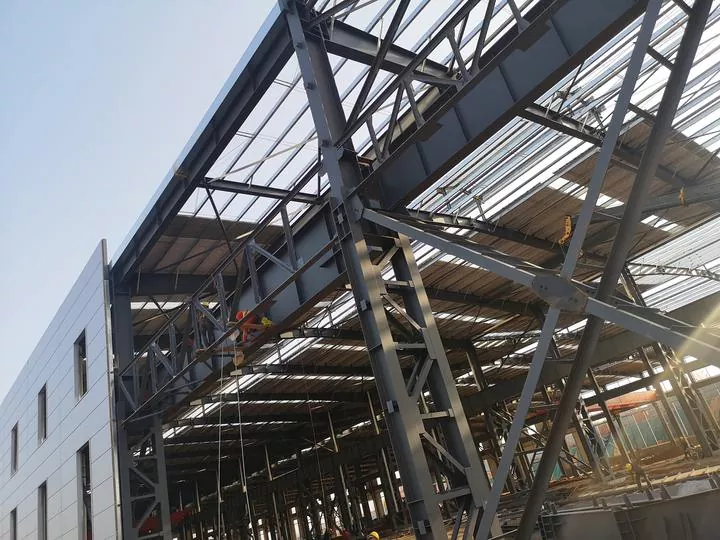
Q2. Functional Differences between Corner Braces and Diagonal Braces
Corner braces serve as out-of-plane supports to secure the global stability of steel beams; diagonal braces are adopted to control the overall lateral deformation of the structure.
Q3. Definition of Plane of Maximum Stiffness
The plane where the cross-section rotates about its major axis is defined as the plane of maximum stiffness. Most steel sections have two centroidal principal axes: the major axis with a larger moment of inertia and the minor axis with a smaller moment of inertia.
Q4. Concept of Post-Buckling Strength
When local buckling occurs in the web of a flexural member, the component will not lose all its load-carrying capacity instantly, and a certain residual bearing performance can still be retained. The design theory that fully exploits and utilizes such residual capacity is known as the design method based on web post-buckling strength.
Q5. Explanation of Second-Order Moment and Second-Order Elastoplastic Analysis
Conventional linear analysis ignores the additional bending moment induced by structural deformation. In contrast, second-order analysis (geometric nonlinear analysis) takes into account the extra bending moment generated by structural deformation under loads, where the relationship between load and deformation presents nonlinear characteristics. On this basis, second-order elastoplastic analysis further incorporates the material nonlinear elastoplastic behavior of steel after yielding for global structural calculation.
Q6. What is the Bauschinger Effect?
After steel is subjected to tensile loading to produce plastic deformation and then unloaded, its yield strength decreases under subsequent reverse loading, and irreversible permanent plastic deformation remains after unloading. This material property is named the Bauschinger effect.
Q7. Formation Mechanism of Lamellar Tearing
Residual stress arises from cooling shrinkage of weld seams after welding. Thin or unrestrained steel plates can expand and contract freely to release internal stress. However, thick plates or stiffened panels are restrained by adjacent components and cannot shrink freely, generating huge tensile stress perpendicular to the plate surface. The local stress in highly restrained areas can be several times the yield strength of steel, eventually causing the plate to tear along its thickness direction, which is defined as lamellar tearing.
Q8. What Type of Failure Mode is Brittle Fracture?
Brittle fracture refers to sudden structural failure without obvious precursors. The actual stress on the cross-section at fracture is far lower than the yield strength and tensile strength of steel. This failure mode originates from the continuous propagation of tiny internal defects inside steel and unstable rapid extension of cracks. Once cracks reach the critical size, they will expand at an extremely high speed, with no plastic deformation warning before failure, resulting in extremely high risks.
Closing Remarks
Reviewing the two volumes: the first volume centers on member stability, while the second focuses on design methods and failure mechanisms. Combined together, they basically cover the key concerns in steel structure engineering: how to ensure member stability, how to conduct structural calculation, and how materials fail. These three interrelated aspects form the core knowledge framework of steel structure design.
It is hoped that these two volumes can help readers establish a clear conceptual system, allowing them to accurately identify the nature of engineering problems and quickly determine corresponding analytical approaches when encountering practical issues. Readers are welcome to communicate and discuss other confusing technical concepts encountered in daily work.
Related News
- Recommended Roof Slope Values for Portal Frames and Light Steel Roof Structures
- Comprehensive Guide: Selecting the Right Exterior Wall Materials for Steel Industrial Facilities
- How Can Steel Structure City Footbridge Construction Accelerate the Formation of the Urban Pedestrian System?
- How Can Cold Chain Storage Be Properly Arranged in a Steel Structure Agricultural Product Logistics Center Construction?
- How do Container Exhibition Hall construction change traditional display spaces?
- How to Select the Appropriate Size for a Steel Frame Horse Stable Construction?
Leave me a message