English
- English
- Esperanto
- Afrikaans
- Català
- שפה עברית
- Cymraeg
- Galego
- Latviešu
- icelandic
- ייִדיש
- беларускі
- Hrvatski
- Kreyòl ayisyen
- Shqiptar
- Malti
- lugha ya Kiswahili
- አማርኛ
- Bosanski
- Frysk
- ភាសាខ្មែរ
- ქართული
- ગુજરાતી
- Hausa
- Кыргыз тили
- ಕನ್ನಡ
- Corsa
- Kurdî
- മലയാളം
- Maori
- Монгол хэл
- Hmong
- IsiXhosa
- Zulu
- Yoruba
- অসমীয়া
- ଓଡିଆ
- Punjabi
- پښتو
- Chichewa
- Samoa
- Sesotho
- සිංහල
- Gàidhlig
- Cebuano
- Somali
- Тоҷикӣ
- O'zbek
- Hawaiian
- سنڌي
- Shinra
- Հայերեն
- Igbo
- Sundanese
- Lëtzebuergesch
- Malagasy
- Español
- Português
- русский
- Français
- 日本語
- Deutsch
- tiếng Việt
- Italiano
- Nederlands
- ภาษาไทย
- Polski
- 한국어
- Svenska
- magyar
- Malay
- বাংলা ভাষার
- Dansk
- Suomi
- हिन्दी
- Pilipino
- Türkçe
- Gaeilge
- العربية
- Indonesia
- Norsk
- تمل
- český
- ελληνικά
- український
- Javanese
- فارسی
- தமிழ்
- తెలుగు
- नेपाली
- Burmese
- български
- ລາວ
- Latine
- Қазақша
- Euskal
- Azərbaycan
- Slovenský jazyk
- Македонски
- Lietuvos
- Eesti Keel
- Română
- Slovenski
- मराठी
- Srpski језик

Recommended Roof Slope Values for Portal Frames and Light Steel Roof Structures
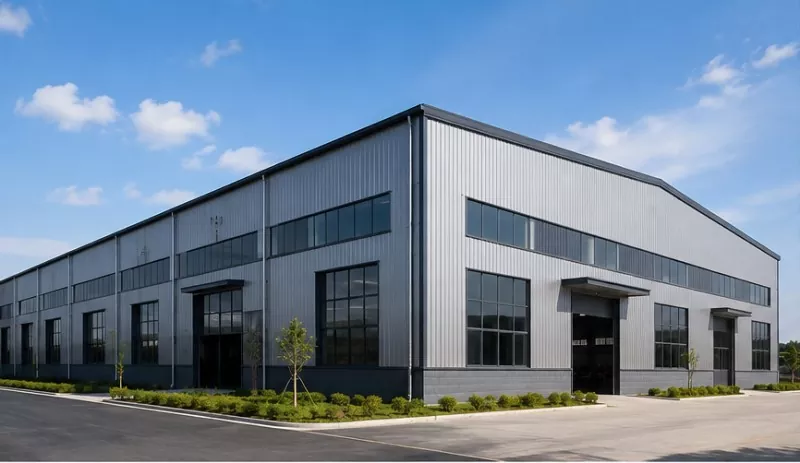
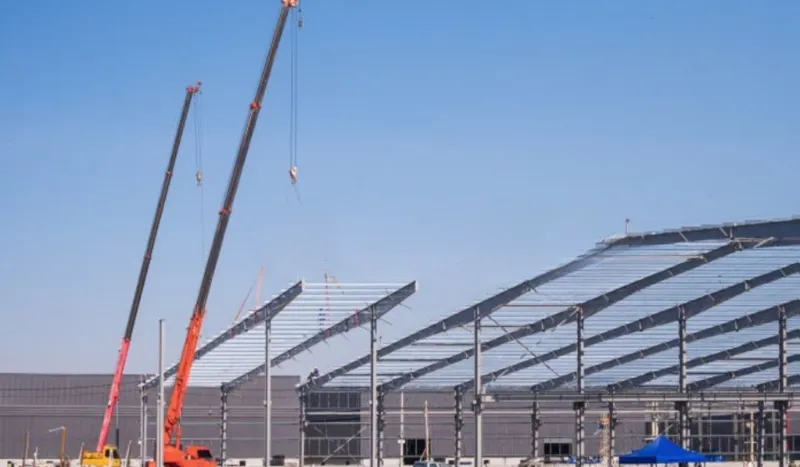
The roof slope should generally be taken as 1/8 to 1/20 (approx. 5% to 12.5%, or 1:8 to 1:20), and the steeper slope value should be selected in regions with heavy rainfall. The slope of the upper flange of the eaves overhang should be identical to the slope of the roof rafter (inclined beam). For portal frames and light steel structures, the commonly used roof slope ranges from 1/8 to 1/20.
Recommended factors to consider when selecting values:
1. Structural deflection of the roof members (rafters and purlins) affects the roof drainage paths. (Clause 3.3.3: The change in roof slope caused by column-top horizontal displacement and member deflection shall not exceed 1/3 of the design slope value.)
2. Roofing materials: The joints between profiled color-coated steel sheets are primary leakage risk points, including fastener (screw) penetrations and flashing details. For concealed-clip panels and standing-seam (mechanically seamed) panels, leakage is rarely an issue as long as on-site installation is carried out properly. However, for screw-down panels fixed directly with self-tapping screws, water leakage can still occur due to thermal expansion and contraction of the steel panels, even if on-site workmanship is meticulous and waterproof sealants are properly applied.
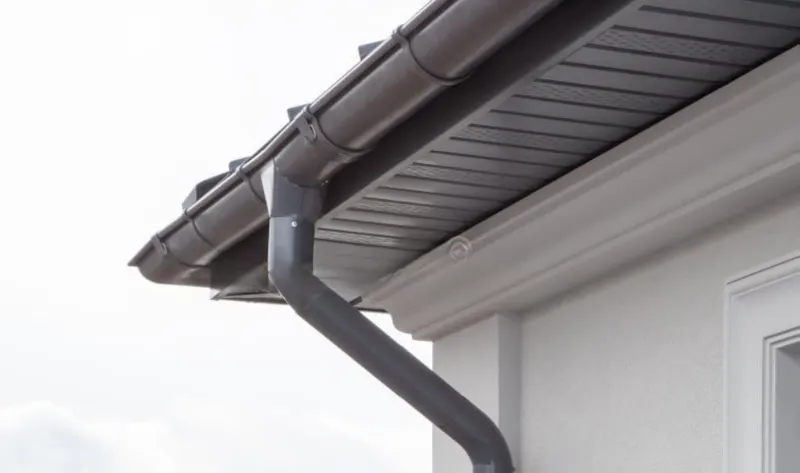
3. Light steel geometry and roof ponding prevention, including transverse and longitudinal gutter slopes. GB 50207-2012 Code for Acceptance of Construction Quality of Roof Engineering, Clause 4.1.3: The longitudinal slope of eaves gutters and valley/inner gutters shall not be less than 1%, and the drop in the gutter bed shall not exceed 200 mm.
4. Environmental factors such as rain, snow, and ice: Heavy rainstorms, severe blizzards, snow accumulation, and ice formation.
5. Operation and maintenance (O&M): Arbitrarily adding loads during building use deforms the roof panels. Similarly, arbitrarily hanging loads from roof purlins causes purlin deflection, resulting in local ponding water. In addition, waterproof sealants and mastic tapes age and degrade over time.
6. Frame span economics and structural stiffness: For single-span portal frames, increasing the roof slope is an effective way to reduce frame weight—a steeper slope reduces bending moments and saves steel. For multi-span frames, a steeper slope increases the height of interior columns. When the building span is large, increasing the slope effectively reduces the vertical deflection of the steel roof beams (rafters).
Recommended Slope Values:
Standard industrial factories: A slope of 1/10 to 1/15 is the most reliable and stable range.
Long single slopes or extended gutters: A slope of not less than 1/10 is recommended.
Multi-span buildings: A slope of 1/20 to 1/15 may be adopted, with close attention paid to interior column height and valley gutter drainage.
Single-span large-span buildings: A slope of 1/10 to 1/8 may be adopted, but detailed checks must be conducted for wind loads, flange braces (corner stays), flashing details, and construction tolerances.
Technical Code for Application of Profiled Metal Sheets in Engineering GB 50896-2013, Clause 5.2.3: The slope of profiled metal sheet roofs shall comply with the following provisions:
1. The slope of a profiled metal sheet roof shall be determined through engineering calculations based on the structural system, sheet profile type, connection details, drainage method, and local climatic conditions;
2. The roof slope of profiled metal sheets shall not be less than 5%; when profiled metal sheets are fastened with exposed fasteners (screws), the roof slope should not be less than 10%;
3. In environments with corrosive dust, the roof slope should not be less than 10%; in environments with medium or strong corrosion levels, the roof slope should not be less than 8%;
4. When determining the roof slope, the relationship between the rib wave height of the profiled sheet and its drainage capacity shall be considered; for gentle roof slopes, high-rib panels should be selected.
Related News
- Comprehensive Guide: Selecting the Right Exterior Wall Materials for Steel Industrial Facilities
- How Can Steel Structure City Footbridge Construction Accelerate the Formation of the Urban Pedestrian System?
- How Can Cold Chain Storage Be Properly Arranged in a Steel Structure Agricultural Product Logistics Center Construction?
- How do Container Exhibition Hall construction change traditional display spaces?
- How to Select the Appropriate Size for a Steel Frame Horse Stable Construction?
- On-Site Steel Structure Assembly + Integral Hoisting Construction Workflow + Key Considerations
Leave me a message