English
- English
- Esperanto
- Afrikaans
- Català
- שפה עברית
- Cymraeg
- Galego
- Latviešu
- icelandic
- ייִדיש
- беларускі
- Hrvatski
- Kreyòl ayisyen
- Shqiptar
- Malti
- lugha ya Kiswahili
- አማርኛ
- Bosanski
- Frysk
- ភាសាខ្មែរ
- ქართული
- ગુજરાતી
- Hausa
- Кыргыз тили
- ಕನ್ನಡ
- Corsa
- Kurdî
- മലയാളം
- Maori
- Монгол хэл
- Hmong
- IsiXhosa
- Zulu
- Yoruba
- অসমীয়া
- ଓଡିଆ
- Punjabi
- پښتو
- Chichewa
- Samoa
- Sesotho
- සිංහල
- Gàidhlig
- Cebuano
- Somali
- Тоҷикӣ
- O'zbek
- Hawaiian
- سنڌي
- Shinra
- Հայերեն
- Igbo
- Sundanese
- Lëtzebuergesch
- Malagasy
- Español
- Português
- русский
- Français
- 日本語
- Deutsch
- tiếng Việt
- Italiano
- Nederlands
- ภาษาไทย
- Polski
- 한국어
- Svenska
- magyar
- Malay
- বাংলা ভাষার
- Dansk
- Suomi
- हिन्दी
- Pilipino
- Türkçe
- Gaeilge
- العربية
- Indonesia
- Norsk
- تمل
- český
- ελληνικά
- український
- Javanese
- فارسی
- தமிழ்
- తెలుగు
- नेपाली
- Burmese
- български
- ລາວ
- Latine
- Қазақша
- Euskal
- Azərbaycan
- Slovenský jazyk
- Македонски
- Lietuvos
- Eesti Keel
- Română
- Slovenski
- मराठी
- Srpski језик

How Can Steel Structure City Footbridge Construction Accelerate the Formation of the Urban Pedestrian System?
With the acceleration of global urbanization, the continuity and safety of the pedestrian system have received increasing attention. Pedestrian bridges, as key nodes of the urban pedestrian network, their construction speed directly affects the efficiency of regional traffic improvement. In recent years, steel structure city footbridge construction, relying on the technical path of factory prefabrication and on-site assembly, are becoming an important force in promoting the rapid formation of the urban pedestrian system. So, how exactly does this construction method shorten the construction period, reduce the impact, and enable the urban pedestrian network to be implemented more quickly?
Table of Contents
1. Factory prefabrication
2. Adapt to diverse urban scenarios
3. Quality control
4. Conclusion
1. Factory prefabrication
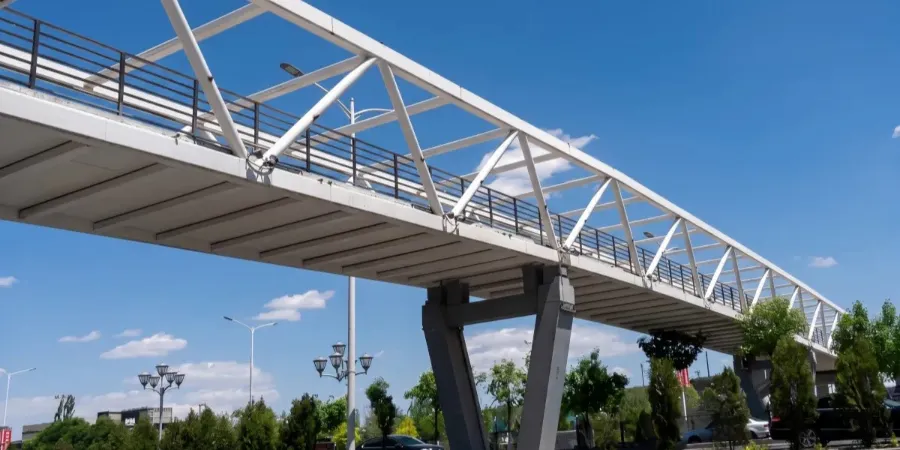
For traditional concrete-structured overpasses, on-site construction is required, involving concrete pouring. The construction period is at least one month. This on-site construction method will seriously affect urban traffic, while the main components of the steel structure city footbridge construction are completed in the factory through processes such as cutting, welding, rust removal, and painting, and then transported to the site in modular units. On-site only requires hoisting, bolt connection, and a small amount of welding. The installation time for a single-span overpass can be shortened to several days or even overnight.
For example, a prefabricated steel overpass with a span of about 30 meters can be completed for traffic access within two weeks from foundation construction to bridge hoisting. This saves more than half of the construction period compared to traditional methods. For urban nodes that need to quickly alleviate traffic conflicts, cooperate with road renovations or rail connections, this speed advantage is particularly crucial.
2. Adapt to diverse urban scenarios
The steel structure city footbridge construction has the advantage of customization. This means that its shape is not uniform. Through modern steel structure processing technology, the span, shape, and color of the overpass can be flexibly adjusted according to the width of the intersection, underground pipelines, and landscape style. At the same time, auxiliary facilities such as railings, paving, lighting, and barrier-free elevators can also be prefabricated simultaneously and installed on-site, reducing waiting time for multi-trade cross-operation.
3. Quality control
The factory-based production of steel structure city footbridge construction transfers the quality control Program completely to the factory production environment. Whether it is weld quality, anti-corrosion treatment, or dimensional accuracy, it can be guaranteed through automated equipment and inspection processes.
Traditional concrete-structured overpass construction uses on-site construction. This construction method involves processing raw materials and construction from start to finish, which is affected by weather conditions, and the construction equipment at the site has low precision, making it prone to quality issues. Prefabricated steel structure overpasses have less post-construction repair and rectification time, thus accelerating the overall project delivery.
4. Conclusion
steel structure city footbridge constructions are one of the key factors in improving the efficiency of urban traffic governance. With the continuous improvement of modularization, standardization, and intelligence levels, Qingdao EIHE Steel Structure Group Co., Ltd. has accelerated the formation speed of future urban pedestrian systems, allowing citizens to enjoy a safer, more convenient, and comfortable crossing experience more quickly.
Related News
- Recommended Roof Slope Values for Portal Frames and Light Steel Roof Structures
- Comprehensive Guide: Selecting the Right Exterior Wall Materials for Steel Industrial Facilities
- How Can Cold Chain Storage Be Properly Arranged in a Steel Structure Agricultural Product Logistics Center Construction?
- How do Container Exhibition Hall construction change traditional display spaces?
- How to Select the Appropriate Size for a Steel Frame Horse Stable Construction?
- On-Site Steel Structure Assembly + Integral Hoisting Construction Workflow + Key Considerations
Leave me a message