English
- English
- Esperanto
- Afrikaans
- Català
- שפה עברית
- Cymraeg
- Galego
- Latviešu
- icelandic
- ייִדיש
- беларускі
- Hrvatski
- Kreyòl ayisyen
- Shqiptar
- Malti
- lugha ya Kiswahili
- አማርኛ
- Bosanski
- Frysk
- ភាសាខ្មែរ
- ქართული
- ગુજરાતી
- Hausa
- Кыргыз тили
- ಕನ್ನಡ
- Corsa
- Kurdî
- മലയാളം
- Maori
- Монгол хэл
- Hmong
- IsiXhosa
- Zulu
- Yoruba
- অসমীয়া
- ଓଡିଆ
- Punjabi
- پښتو
- Chichewa
- Samoa
- Sesotho
- සිංහල
- Gàidhlig
- Cebuano
- Somali
- Тоҷикӣ
- O'zbek
- Hawaiian
- سنڌي
- Shinra
- Հայերեն
- Igbo
- Sundanese
- Lëtzebuergesch
- Malagasy
- Español
- Português
- русский
- Français
- 日本語
- Deutsch
- tiếng Việt
- Italiano
- Nederlands
- ภาษาไทย
- Polski
- 한국어
- Svenska
- magyar
- Malay
- বাংলা ভাষার
- Dansk
- Suomi
- हिन्दी
- Pilipino
- Türkçe
- Gaeilge
- العربية
- Indonesia
- Norsk
- تمل
- český
- ελληνικά
- український
- Javanese
- فارسی
- தமிழ்
- తెలుగు
- नेपाली
- Burmese
- български
- ລາວ
- Latine
- Қазақша
- Euskal
- Azərbaycan
- Slovenský jazyk
- Македонски
- Lietuvos
- Eesti Keel
- Română
- Slovenski
- मराठी
- Srpski језик

Analysis of Steel Structure Production Technology
Ⅰ. Overview
Steel structure fabrication is the process of converting design drawings into physical structural components. Its core is to process steel materials into qualified steel structural members in compliance with design requirements through factory production procedures, while keeping the sectional properties of steel basically unchanged.
The production technology of steel structures is generally similar to that of mechanical manufacturing. However, given that steel structure products are ultimately assembled on construction sites, its processes place greater emphasis on precision control and deformation prevention.
Ⅱ. Process Flow Chart of Steel Structure Production
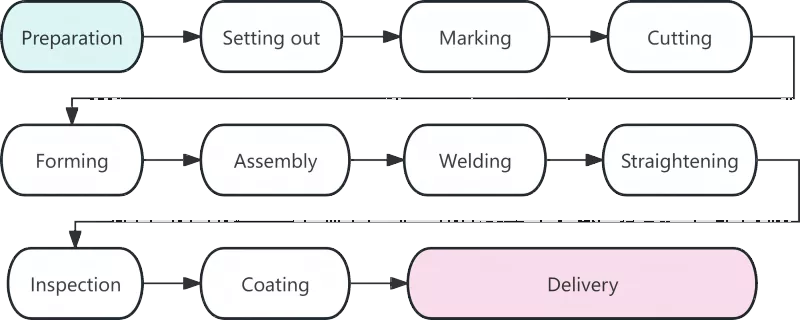
Ⅲ. Detailed Analysis of Each Working Procedure
|
Process |
Description |
|
Material Preparation |
Material preparation marks the start of steel structure fabrication, and its quality directly affects all subsequent working procedures. The core tasks at this stage include material acceptance, straightening and surface cleaning. After steel materials arrive at the factory, their material certificates shall be checked against the actual products. Re-inspection on chemical composition and mechanical properties shall be conducted for steels used in major structural components. Deformed steels caused during transportation shall be straightened using roller straighteners or hydraulic jacking machines. Experience shows that approximately 80% of dimensional errors in blanking result from unstraightened raw materials. |
|
Lofting |
Lofting is the first critical step for precision control in steel structure manufacturing. On dedicated platforms or layout tables, technicians draw full-scale component joints and outlines at a ratio of 1:1 in accordance with design drawings to define the shapes of parts. In addition to verifying drawing dimensions, welding shrinkage allowance shall be reserved as required by relevant processes. Generally, an allowance of 1 to 1.5 millimeters shall be set aside for each butt weld. |
|
Marking |
Also known as scribing, marking refers to the procedure of using templates to mark hole positions and machining lines for component outlines on steel plates and sections. The principle of "large parts first, small parts later" is followed to maximize material utilization rate. Through optimized layout, the overall material utilization rate can reach over 85%, and it can even exceed 92% after nesting optimization. |
|
Cutting |
Cutting is the process of separating raw materials into individual parts along marked lines. The mainstream cutting methods include gas cutting, plasma cutting and laser cutting. The widespread application of numerical control cutting technology has improved the precision and efficiency of steel structure fabrication. Some cut surfaces are qualified for direct welding without secondary edge processing. |
|
Forming |
Non-linear components such as curved beams and bent pipes shall be shaped via cold bending or hot bending. Cold bending is performed at room temperature and applicable to common curved components. For hot bending, steels are heated to 900-1100°C before bending, which is adopted for thick plates or components with small bending radii. |
|
Assembly |
Assembly means combining processed parts as required by drawings and temporarily fixing them by tack welding. The standard assembly procedure is as follows: Grind splice seams of flange plates → Remove burrs on web plates → Achieve precise positioning with an assembly machine → Complete assembly of single-sided T-section steel → Flip the assembly and finish overall forming. |
|
Welding |
Welding is the core procedure in steel structure manufacturing with high technical requirements and stringent quality control. The commonly used welding methods include automatic submerged arc welding, CO₂ gas shielded welding and shielded metal arc welding. |
|
Straightening |
Thermal stress generated during welding will cause component deformation, which shall be eliminated by straightening to restore the original geometric shape. Common straightening methods include mechanical straightening, flame straightening and combined straightening. Heating on the same position shall not be conducted more than three times, and overheating is strictly prohibited. |
|
Inspection |
Running through the entire manufacturing process, inspection serves as a key guarantee for product quality. Phased inspection mainly covers raw material inspection, in-process inspection and post-welding inspection. Fatal defects such as cracks and incomplete fusion are not allowed inside welds. |
|
Coating |
Coating provides anti-corrosion and fire protection for steel structures. The standard coating system consists of three layers: zinc-rich epoxy primer, epoxy micaceous iron intermediate coat, and polyurethane or fluorocarbon topcoat. Fire-resistant coating shall be applied in multiple thin coats. The ambient temperature for coating operation shall be no lower than 5°C, the relative humidity shall not exceed 85%, and the surface temperature of steel shall be at least 3°C higher than the dew point. |
|
Delivery from Factory |
Delivery is the final step of steel structure manufacturing. Components that pass the final inspection will be assigned unique serial numbers and marks. Components shall be bundled in groups according to the installation sequence. Wood blocks or rubber gaskets shall be placed between components to prevent coating scratches. |
IV. Development Trends of Modern Steel Structure Manufacturing Technology
Modern steel structure manufacturing is increasingly intelligent and mechanized to improve production precision and efficiency. Numerical control technology, automatic welding, BIM application and virtual simulation for pre-assembly represent the future development trends of the industry.
Steel structure production is a complete system featuring closely connected processes, high precision requirements and strict quality control. Every procedure from layout to coating directly affects the quality of finished products. With the widespread application of intelligent technologies, stricter standards will be adopted for steel structures, leading to further improvement in product quality.
Related News
- How to Choose C and Z Purlins for Steel Structure Warehouses?
- Which Residential Projects Are Suitable for Modular Shipping Container Homes?
- What Are the Differences Between Prefabricated Container Motel Construction and Traditional Motels?
- What construction costs can be reduced by using steel structure canteen construction?
- What Are the Application Scenarios of Customized Residential Container Warehouse Construction?
- Recommended Roof Slope Values for Portal Frames and Light Steel Roof Structures
Leave me a message





News Recommendations