English
- English
- Esperanto
- Afrikaans
- Català
- שפה עברית
- Cymraeg
- Galego
- Latviešu
- icelandic
- ייִדיש
- беларускі
- Hrvatski
- Kreyòl ayisyen
- Shqiptar
- Malti
- lugha ya Kiswahili
- አማርኛ
- Bosanski
- Frysk
- ភាសាខ្មែរ
- ქართული
- ગુજરાતી
- Hausa
- Кыргыз тили
- ಕನ್ನಡ
- Corsa
- Kurdî
- മലയാളം
- Maori
- Монгол хэл
- Hmong
- IsiXhosa
- Zulu
- Yoruba
- অসমীয়া
- ଓଡିଆ
- Punjabi
- پښتو
- Chichewa
- Samoa
- Sesotho
- සිංහල
- Gàidhlig
- Cebuano
- Somali
- Тоҷикӣ
- O'zbek
- Hawaiian
- سنڌي
- Shinra
- Հայերեն
- Igbo
- Sundanese
- Lëtzebuergesch
- Malagasy
- Español
- Português
- русский
- Français
- 日本語
- Deutsch
- tiếng Việt
- Italiano
- Nederlands
- ภาษาไทย
- Polski
- 한국어
- Svenska
- magyar
- Malay
- বাংলা ভাষার
- Dansk
- Suomi
- हिन्दी
- Pilipino
- Türkçe
- Gaeilge
- العربية
- Indonesia
- Norsk
- تمل
- český
- ελληνικά
- український
- Javanese
- فارسی
- தமிழ்
- తెలుగు
- नेपाली
- Burmese
- български
- ລາວ
- Latine
- Қазақша
- Euskal
- Azərbaycan
- Slovenský jazyk
- Македонски
- Lietuvos
- Eesti Keel
- Română
- Slovenski
- मराठी
- Srpski језик

What Are the Differences Between Prefabricated Container Motel Construction and Traditional Motels?
With the rapid development of modular construction, Prefabricated container motel construction are becoming a new solution for commercial motel buildings. Both of them serve self-driving travelers and emphasize convenient parking, quick check-in, and standardized rooms. However, there are also different differences between them. Where are these differences? This article will discuss them from multiple perspectives with everyone.
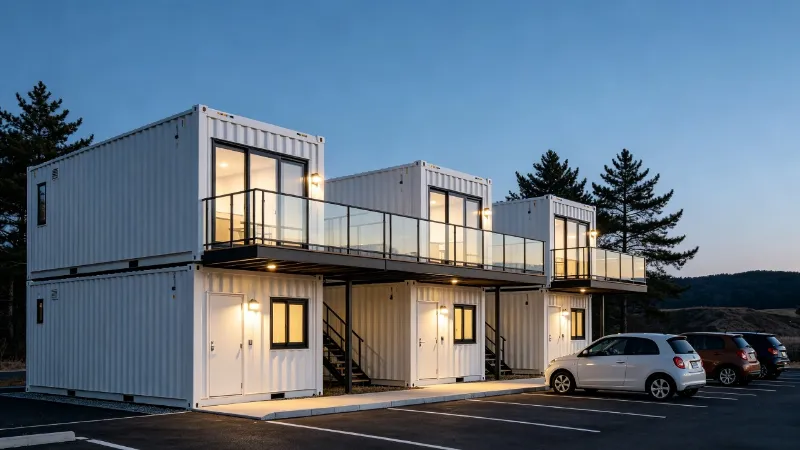
Table of Contents
1. Construction Logic
2. Construction Period
3. Space and Layout
4. Environmental and Sustainable
5. Conclusion
1. Construction Logic
Traditional motels usually adopt brick-concrete, wood structure or light steel structure. They need to be built on-site and complete multiple processes such as foundation, main body, water and electricity, exterior wall, roof, and interior decoration. They are greatly affected by weather, manpower and on-site management.
Prefabricated container motel construction, on the other hand, use containers as modular units. They are cut, reinforced, insulated, have doors and windows, bathrooms, water and electricity, and interior decoration completed in the factory, and then transported to the site for hoisting and assembly. The on-site work mainly focuses on foundation, pipeline connection, exterior facade and public areas. Traditional motels are more like building houses on-site, while pre-fabricated container motels are more like manufacturing rooms in the factory and assembling them on-site.
2. Construction Period
The construction period of traditional motels from design to construction, acceptance and beyond is usually long. It may be delayed due to rainy seasons, winter or labor shortages.
Most of the processes of Prefabricated container motel construction are completed in the factory. The on-site work mainly involves hoisting and connection. The overall period is usually shorter and is more suitable for projects that require quick opening and seizing the peak traffic flow.
3. Space and Layout
|
Comparison dimensions |
Traditional motels |
Prefabricated container motel construction |
|
Layout flexibility |
High |
Can be joined together, customizable in height |
|
Room area |
Can be freely set |
Each container has a limited area, multiple containers can expand the space |
|
Corridor form |
Single-story or two-story veranda style |
Can be used as an exterior corridor, interior corridor, or staggered connecting corridor |
|
Roof shape |
Can be made into pitched roof, flat roof, or shaped roof |
Most have a flat roof, can be equipped with a pergola or pitched roof |
|
Exterior facade |
Regular materials, with a relatively conventional style |
Industrial style, painting, wood finish, metal plates |
|
Toilet layout |
Free layout |
Centralized or modular bathrooms are required |
|
Expansion and renovation |
Difficult, high cost |
Modules can be added or removed, and can be moved |
4. Environmental and Sustainable
Since traditional motels require on-site construction for the current project, they generate a large amount of dust, noise and construction waste. In addition to causing environmental pollution, it also incurs costs for waste disposal.
Prefabricated container motel construction utilize retired containers or factory production, which can reduce on-site waste. Steel is a globally recognized environmentally friendly material that does not cause pollution to the land. Additionally, the insulation materials of the houses are new and environmentally friendly materials, and their insulation and heat insulation effects are better than traditional brick-concrete structures, which can save energy usage.
5. Conclusion
Prefabricated container motel constructions are not a simple substitute for traditional motels, but a more rapid, flexible and modular accommodation product. Qingdao EIHE Steel Structure Group Co., Ltd provides architectural solutions for global clients that offer scalable chains and differentiated experiences, allowing for the integration of fast, stable and personalized products into modern life.
Related News
- What construction costs can be reduced by using steel structure canteen construction?
- What Are the Application Scenarios of Customized Residential Container Warehouse Construction?
- Recommended Roof Slope Values for Portal Frames and Light Steel Roof Structures
- Comprehensive Guide: Selecting the Right Exterior Wall Materials for Steel Industrial Facilities
- How Can Steel Structure City Footbridge Construction Accelerate the Formation of the Urban Pedestrian System?
- How Can Cold Chain Storage Be Properly Arranged in a Steel Structure Agricultural Product Logistics Center Construction?
Leave me a message
New Products




News Recommendations